Understanding the ATV Difference
An ATV can feel easy in the first few meters—and completely unforgiving when slopes, ruts, mud, or rocks appear. This isn't a motorcycle or a car. On an ATV, you work with your body, actively control traction, and must understand how the machine responds to throttle, brakes, weight transfer, and terrain changes.
This comprehensive guide covers everything: setup, technique, common beginner mistakes, training exercises, and riding in challenging conditions (mud, climbs, descents, ruts, water, sand). Treat it as a manual and return to it throughout your training.
Before You Ride: Safety Fundamentals That Save Lives
Protective Gear (Not Optional)
- Helmet: Full-face or off-road style with goggles
- Goggles: Rocks and mud fly like projectiles in terrain
- Gloves: Protection and grip
- Boots: Off-road or high, rigid footwear (ankle protection is critical)
- Knee/elbow guards or full body armor
- Long sleeves: Abrasions and branches are real
Golden Rules
- Never ride alone into difficult terrain without telling someone your location
- Phone in waterproof case + power bank
- No alcohol—not even "just one beer"
- In serious terrain: ideally a second person plus recovery gear (winch/straps/kinetic rope)
Know Your Machine: Pre-Ride Essentials
60-Second Pre-Ride Check
- Tires: Pressure, sidewall damage
- Brakes: Even engagement
- Throttle: Returns smoothly
- Lights / kill switch: Functional
- Play: Wheels, steering
- Fluids: Oil, coolant (when time permits)
Critical Controls to Master
Throttle (thumb or twist grip)
Brakes (hand/foot depending on model)
Reverse and lock (R position)
Drive modes: 2WD/4WD, differential lock
CVT Range:
- H (High): Normal riding, hard surfaces
- L (Low): Climbs, mud, slow technical work, winching, towing
In serious terrain, Low is your best friend.
Position and Balance: The Foundation of ATV Riding
ATVs don't flip because they're "bad machines"—they flip because riders sit like they're in an armchair.
Rule #1: Your Body Does the Work
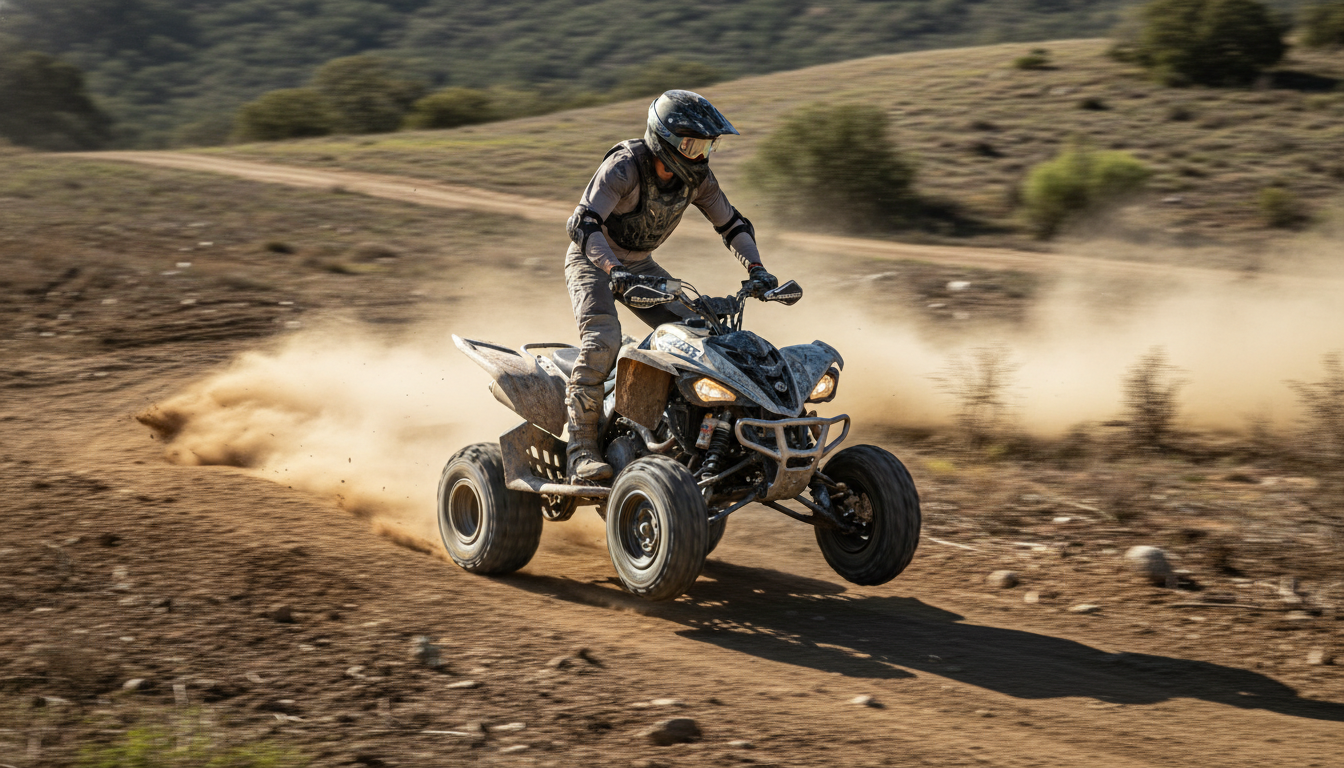
- In terrain, ride in a half-standing position (knees slightly bent, weight on footpegs)
- Arms relaxed, elbows up (not hanging on the handlebars)
- Eyes far ahead, not at the front wheel
Turning an ATV (The Key Difference vs. Cars)
In a turn, the ATV wants to go straight. For stable cornering:
- Transfer weight toward the inside of the turn
- Press down on the outside footpeg (for stability)
- Don't chop the throttle mid-turn (causes slides or front-end lift)
Pro Tip: Your hips and shoulders "point" where you're going. The handlebars are just a tool.
Learning from Zero: Flat Ground Training Exercises
Find a large, flat area (field, parking lot) and work through these exercises in sequence.
Exercise 1: Starting and Stopping
- Start smoothly without jerking
- Brake gently and straight
- Stop at a designated point
Goal: Feel the throttle and brake response.
Exercise 2: Slalom (Line Control)
Set up 5-8 markers (bottles work). Ride slowly and precisely.
- Balance with your body
- Don't "fight" the handlebars
- Look at the next marker, not the current one
Exercise 3: Emergency Braking
From low speed (gradually increase):
- Straight line only
- Progressive braking (increasing force, not maximum from the start)
- Feel when wheels begin losing grip
Exercise 4: Tight-Space U-Turn
- Slow, controlled throttle
- Work with body weight
- Learn to recognize when the ATV "rises" onto outer wheels—that's your signal to shift weight
Common Beginner Mistakes (And How to Fix Them)
| Mistake | Consequence | Fix |
|---|---|---|
| Sitting like in an armchair | No lean control | Active stance, weight on footpegs |
| Looking at front wheel | Delayed reactions | Eyes far ahead |
| Panic throttle chop in turns | Destabilization | Maintain steady throttle through turns |
| Too fast into holes/ruts | Handlebar snatch, lost line | Slow entry, let suspension work |
| Wrong 4x4/lock use | Drivetrain stress | Engage at low load, not full throttle |
| Using H instead of L in technical terrain | CVT overheating, no control | Default to L in challenging conditions |
Terrain Techniques: How to Ride Difficult Conditions
A) Ruts and Side-Hill Traverses
This is where ATVs flip most often.
Rules:
- Keep speed low
- Shift weight toward the uphill side
- Avoid sudden turns downhill
- If the ATV starts leaning: don't panic—weight the uphill side, straighten the line, gently add throttle
Never: Make sharp turns in ruts on a slope.
B) Climbs
Critical: Don't stop halfway and don't try to turn around in panic.
Technique:
- Choose your line before starting the climb
- Engage Low (and 4WD if slippery)
- Stand or half-stand, weight forward
- Maintain steady throttle (no wheelspin bursts)
When you lose power/traction:
- DO NOT turn the ATV across the slope
- Stop, hold brake, descend straight down controlling with brake and engine (Low helps)
C) Descents
"Late braking" and locked wheels kill here.
Technique:
- Low range
- Weight rearward
- Descend straight, slowly
- Brake progressively (never lock the wheels)
D) Mud
Mud is about traction and momentum.
Technique:
- Maintain steady, controlled "pull"
- Avoid fully releasing throttle (you'll dig in)
- 4WD helps but doesn't replace proper tires and technique
- If you start digging: gentle front-back rocking, don't pointlessly spin the wheels
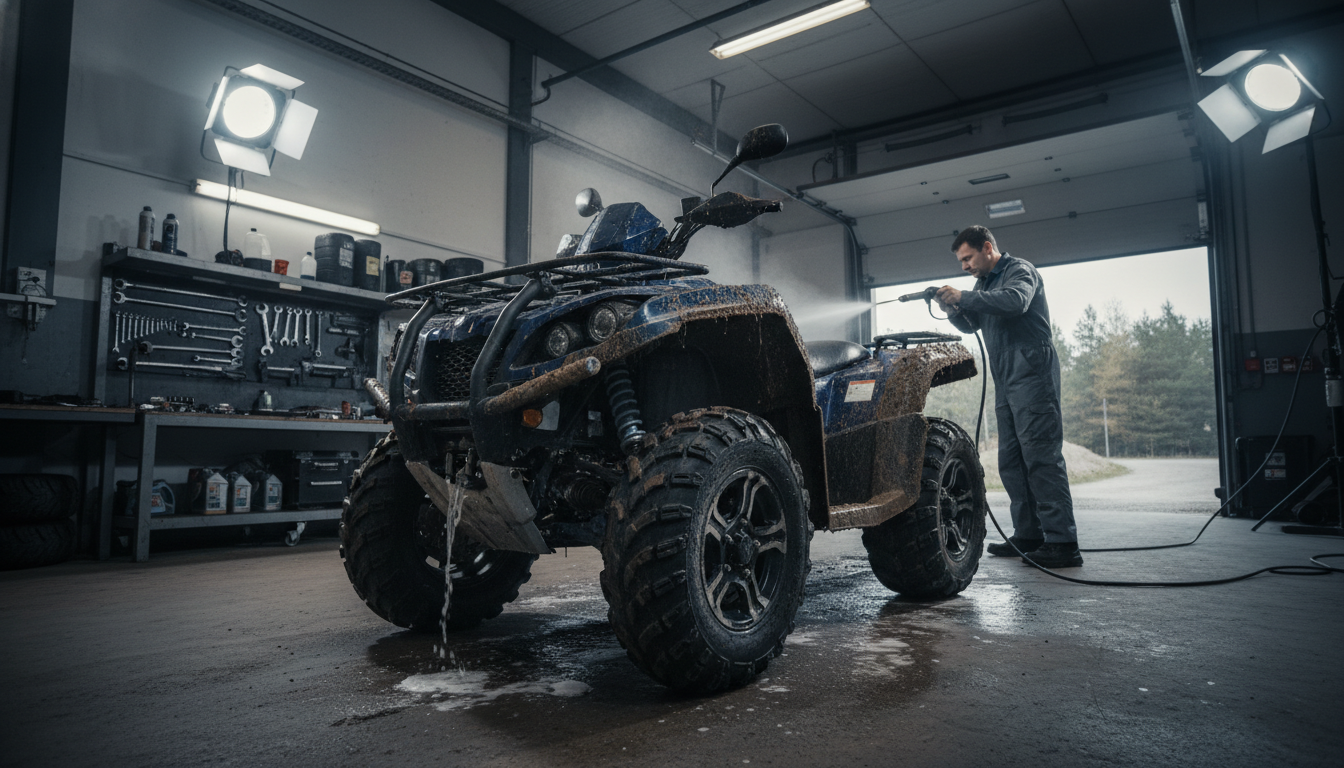
Important: After deep mud, clean the radiator and check the air filter.
E) Sand
In sand, the ATV "floats" and the front tends to dive.
Technique:
- Slightly higher speed for stability (but controlled)
- Weight slightly rearward
- Wider, smoother turns
- Don't brake hard with the front in soft sand
F) Rocks and Roots
Precision and soft hands matter here.
Technique:
- Slow, half-standing position
- Don't death-grip the bars—let them work
- Choose lines where wheels roll over high points, not between them
G) Water Crossings
This is the most common way to cause mechanical failures (water in filter/CVT/differentials).
Rules:
- Check the bottom with a stick (hidden holes!)
- Enter slowly, maintain steady throttle
- Don't stop in the middle
- Dry the brakes after exiting
After deep water: Check oils (differentials/gearbox), CVT housing, air filter.
2WD / 4WD / Diff Lock: Smart Usage
| Mode | Best For |
|---|---|
| 2WD | Hard, dry surfaces; turns; drivetrain efficiency |
| 4WD | Slippery conditions, sand, mud, climbs, ruts |
| Diff Lock | When traction is truly needed (deep mud, difficult climbs) |
Safe Practices:
- Don't engage diff lock on hard surfaces
- Switch modes at low load (not at full throttle)
- With lock engaged, steering is heavier—plan turns accordingly
Group Riding and Trail Communication
- Maintain distance (rocks and mud fly from wheels)
- Establish hand signals (stop, problem, direction)
- Experienced rider leads (sets the pace), capable rider at the rear (helps if needed)
Recovery: When You Get Stuck
Stuck in Mud
- Don't spin wheels pointlessly
- Assess: Is the front stuck? Rear? Frame sitting?
- Dig around wheels, place branches/mats underneath
- Use winch or kinetic recovery strap
Winch Basics
- Always wear gloves
- Control the line, never stand in the pull axis
- Use a damper/weight on the line if available
4-Week Training Plan
Week 1: Control and Braking
- Starting, stopping, slalom
- Emergency braking on straight lines
Week 2: Turns and Balance
- Turns at increasing speeds
- Body weight transfer practice
Week 3: Light Terrain
- Small climbs and descents
- Ruts, grass, light sand
Week 4: Challenging Terrain (With Backup)
- Mud, technical sections
- Conscious 4WD and Low usage
- Practice "getting stuck" and safe extraction
Pre-Terrain Checklist
Before heading into serious terrain, verify:
- [ ] Helmet/goggles/gloves/boots—check
- [ ] Phone + power bank—check
- [ ] Recovery straps/kinetic rope/winch—functional
- [ ] Low range works, 4WD works
- [ ] Air filter clean
- [ ] Radiator clear
- [ ] Riding with someone, or someone knows your location
The Bottom Line
Learning to ride an ATV isn't just "throttle and steering." It's fundamentally about:
- Body balance and active riding stance
- Working the footpegs to control weight
- Line selection and reading terrain
- Conscious use of Low / 4WD / diff lock
- Speed and braking control appropriate to conditions
Master these fundamentals, and the machine becomes an extension of your intentions. Skip them, and even the best ATV will work against you.
Start slow. Build systematically. The terrain will always be there—take the time to develop the skills that let you enjoy it safely.